Call Now (561) 414-0653 Call Now (561) 414-0653 Call Now (561) 414-0653
Fast delivery within 24 to 48 hours. Fast delivery within 24 to 48 hours. Fast delivery within 24 to 48 hours.

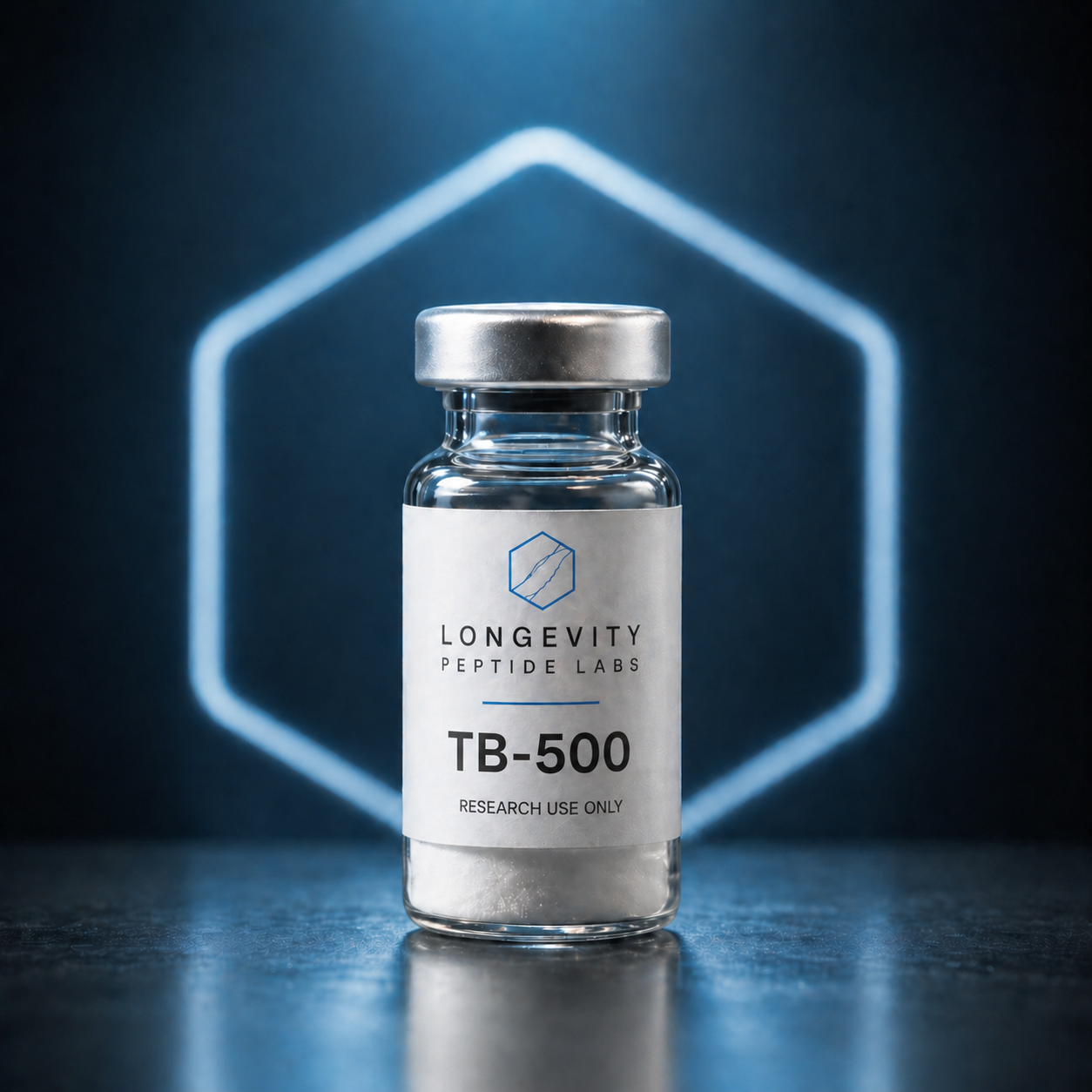
TB-500 10mg

$99.00

Scientific Overview

  • Product Name: TB‑500 (Thymosin Beta‑4)

  • Category: Synthetic peptide for research use only

  • Intended Use: In vitro research, cell migration and tissue repair investigations

  • Source: Recombinant or synthetic peptide preparation

  • Appearance: Lyophilized (freeze‑dried) white to off‑white powder

  • Molecular Formula: C₆₅₈H₁₀₅₁N₁₆₇O₂₀₅S₅ (approximate — dependent on sequence variant)

  • Molecular Weight: ~4,960 Da (approximate)

  • Amino Acids: 43‑residue peptide sequence (human thymosin beta‑4 fragment)

  • CAS Number (if assigned): Not universally standardized, may vary by supplier

  • Common Synonyms: TB500, Thymosin β4 fragment

  • Use Restriction: For in vitro research only — Not approved for therapeutic or human use

Please Note: These products are intended strictly for laboratory research purposes only. They are not for human consumption, medical use, or veterinary application.
Disclaimer: If multiple different peptides are purchased, they must be injected separately. Mixing them in the same syringe can alter the pH balance, which may cause adverse side effects.
COA Verified

Trusted medications

Licensed Pharmacy

Certified & regulated

Secure Checkout

Protected payments

Fast Delivery

24~48 hours

Related Items

Sequence & Structure

  • Synthetic peptide representing the active fragment of the natural Thymosin Beta‑4 protein

  • Designed to promote cellular migration and repair pathways in research models

Purity Standards

  • Typical purity: ➤ ≥98 % by HPLC analysis (often reported as high as ≥99 %)

  • Confirmed by analytical HPLC and/or mass spectrometry

  • Low levels of detectable impurities

Assay / Activity

  • Verified by HPLC peak area showing a dominant peptide peak

  • Mass spectrometry (MS) confirms correct mass for peptide sequence

  • Bioactivity demonstrated via cell migration or proliferation assays in research settings

    • Analytical Purity:

      • HPLC showed single major peak with ≥98 % area

      • Identity confirmed via MS showing matching molecular mass

    • Endotoxin Levels:

      • Some research‑grade batches have low endotoxin (<0.1 EU/µg), if tested

    • Batch‑Specific COA:

      • Purity percentage by HPLC

      • MS identity and retention time data

      • Peptide content per vial

      • Storage guidance

  • Lyophilized Powder (Unopened)

    • Short‑Term: Store at 2‑8 °C (refrigerator)

    • Long‑Term: Store at ‑20 °C to ‑80 °C (preferred for maximum stability)

    • Store in a dry, dark, airtight container

    • Include desiccant to reduce moisture uptake

    Reconstituted (After Adding Solvent)

    • Reconstitute with sterile water or appropriate buffer immediately before use

    • Short‑Term Use: 2‑8 °C for up to 7 days

    • Mid‑Term: Freeze single‑use aliquots at ‑20 °C/‑80 °C (avoid repeated freeze‑thaw cycles)

    • Avoid repeated thawing; cycles degrade peptide integrity

    Stability Considerations

    • Peptides may degrade upon moisture exposure, light, or oxidation

    • Clear solutions with no particulates indicate good condition

  • Lyophilized Powder (Unopened)

    • Short‑Term: Store at 2‑8 °C (refrigerator)

    • Long‑Term: Store at ‑20 °C to ‑80 °C (preferred for maximum stability)

    • Store in a dry, dark, airtight container

    • Include desiccant to reduce moisture uptake

    Reconstituted (After Adding Solvent)

    • Reconstitute with sterile water or appropriate buffer immediately before use

    • Short‑Term Use: 2‑8 °C for up to 7 days

    • Mid‑Term: Freeze single‑use aliquots at ‑20 °C/‑80 °C (avoid repeated freeze‑thaw cycles)

    • Avoid repeated thawing; cycles degrade peptide integrity

    Stability Considerations

    • Peptides may degrade upon moisture exposure, light, or oxidation

    • Clear solutions with no particulates indicate good condition

Call Us Now